

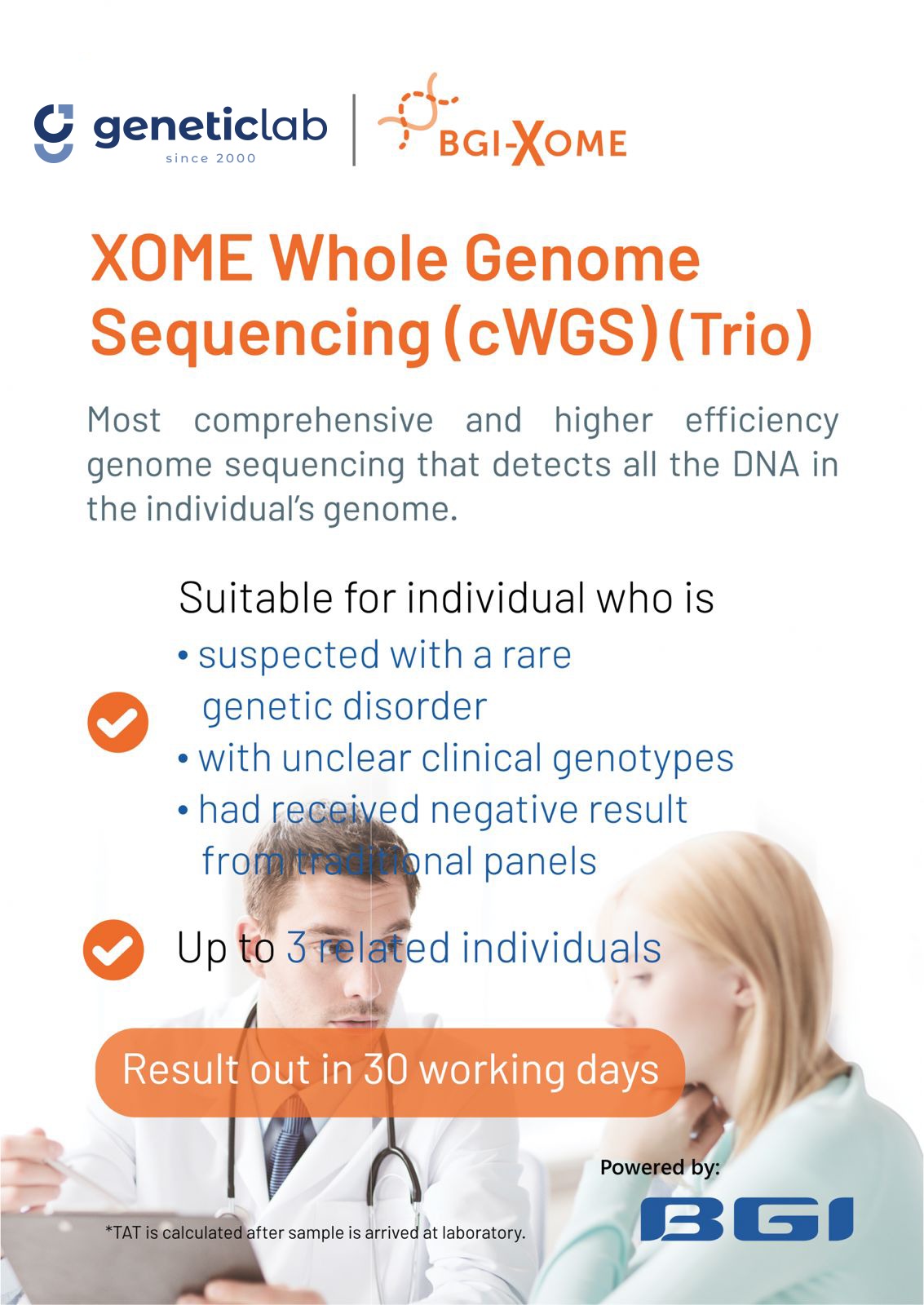
Clinical Whole Genome Sequencing for the most comprehensive diagnosis.
When monogenetic diseases present with complicated or combined phenotypes, cWGS analyses the entire human genome in a single workflow — reaching a higher possibility of a clear molecular diagnosis than exome or panel-based approaches.
Clinical scope
What clinical challenges does cWGS target?
Hereditary diseases can be caused by single-gene mutations, mutations across multiple genes, gene–environment interactions, or chromosomal damage. Each conventional methodology — Sanger, CMA, CNV-seq, exome — captures only a portion of the variant landscape. cWGS delivers the most comprehensive overview in a single test.
A patient with abnormal clinical manifestations suspected to be caused by hereditary diseases.
A patient who has a family history of monogenic diseases.
A couple who have experienced a previous miscarriage without a clear diagnosis.
Important features
One test, the full variant catalogue.
Simultaneous analysis of over 22,000 human genes, including 4,900+ known disease-causing genes from OMIM and 6,400+ single-gene disorders, with phenotype-focused interpretation.
Variant types — official report
Variant types — supplementary report
| Product Name | XOME™ Clinical Whole Genome Sequencing (cWGS) |
|---|---|
| Gene numbers | Over 22,000 protein coding genes |
| Sequencing range | Whole genome |
| Sequencing depth | ≥40X |
| 20X coverage | ≥90% |
| Sample type | Peripheral blood / Genomic DNA / Amniotic fluid (Trio) |
| Turnaround time | 30 working days |
| Delivery location | Hong Kong – Shenzhen |
Note: Amniotic fluid samples must be submitted alongside parental samples for trio analysis. TAT is calculated from Hong Kong centre sample acceptance to Shenzhen laboratory report release.
Why choose cWGS
Comprehensive, accurate, and safe.
Accurate
Mean depth of BGI-XOME cWGS is over 40X, with 20X coverage ≥90% across the genome.
Comprehensive
Detects point mutations, indels, CNVs, mitochondrial variations, LOH, translocations, inversions, and dynamic mutations across all 3 billion base pairs and 22,000+ protein-coding genes in a single test.
Multiple sample types
Accepts saliva, peripheral blood, genomic DNA, and amniotic fluid for trio investigations.
Safe
A safe, non-invasive method for comprehensive genetic analysis of the entire genome.
DNBSEQ platform
DNA Nanoball technology behind XOME cWGS.
XOME cWGS runs on BGI DNBSEQ, a clinical-grade sequencing platform used across national genome programmes and clinical genome laboratories worldwide. DNBSEQ uses DNA Nanoball (DNB) arrays generated by rolling circle replication and combinatorial Probe-Anchor Synthesis (cPAS), delivering industry-leading accuracy, low duplication rates, minimal index hopping, and consistent coverage depth — critical for whole genome variant calling at ≥40X across 3 billion base pairs.
DNA Nanoball (DNB) arrays
Rolling circle replication amplifies each template into a tight nanoball, eliminating PCR-clone duplicates and preserving allelic balance for confident heterozygous variant calls.
cPAS sequencing chemistry
Combinatorial Probe-Anchor Synthesis delivers Q30 ≥ 85% base quality and paired-end 100/150 bp reads — the foundation of reliable SNV, Indel, and CNV detection across the genome.
PCR-free library workflow
PCR-free library preparation reduces GC bias and improves uniform coverage in difficult regions, including repeat-rich loci, promoters, and structural variant breakpoints.
Minimal index hopping
The patterned DNB flow cell architecture suppresses sample-to-sample crosstalk, protecting variant allele fractions in trio and family-based analyses.
Clinical-grade coverage
Mean genome depth of ≥40X with ≥90% of bases covered at 20X — sensitivity sufficient for mosaicism review and small CNV resolution alongside SNV and Indel calling.
Globally validated platform
DNBSEQ instruments power large-scale clinical genome programmes, prenatal screening, and oncology workflows — the same chemistry that backs every XOME cWGS report.
Service process
From physician order to report.
- 1Step 1Physician orders test
- 2Step 2Sample collected from patient
- 3Step 3Sample shipped to geneticlab
- 4Step 4DNA extraction & quality check
- 5Step 5Library preparation & sequencing
- 6Step 6Bioinformatics analysis
- 7Step 7Clinical interpretation
- 8Step 8Report delivered to physician
FAQ
Frequently asked questions
Eligibility, turnaround time, and sample requirements for XOME cWGS.
Speak with the team
Get the right XOME pathway for your patient, family, or service line.
Call geneticlab directly for service access, logistics, and next-step guidance.